UWA and me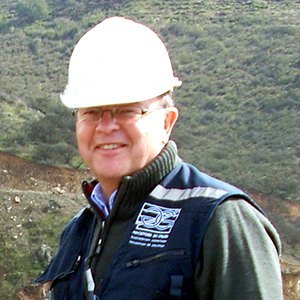
My introduction to UWA was taking up a position with the Australian Centre for Geomechanics (ACG) in 2005.
The ACG is based at UWA and provides training and research for the Australian mining industry. The high standing of the ACG in Australia provided me an incredible, fast-tracked opportunity to collaborate with industry.
It led to a number of large research grants and contacts that helped tremendously when I moved to the School of Civil, Environmental and Mining Engineering, where I have been based since 2008, including a three-year term as Head of School.
Future-proofing our engineering graduates
Although the mining sector is going through a tough time right now, it will surely pick up again, as it always does.
The cyclical nature of the industry makes it extremely difficult to prepare the right number of graduates for industry. I believe this is partly because the traditional model for mining engineering education is flawed. By focussing on conventional curricula during the undergraduate degree (as done at virtually all mining schools), we increase the vulnerability of graduates to downturns, as is currently happening.
One way we plan to address this at UWA is to take advantage of the incredible flexibility in course selection provided by our 3+2 model. In particular, we are developing an option in which students combine mining engineering and computer science topics, with possible future employment options including mining automation, a field that is expanding exponentially. It will also allow graduates to move between jobs during mining downturns, with their computer science expertise able to be utilised in other applications.
A global impact
Since experiencing first-hand the devastating impacts of the failure of a mine tailings dam, my research has focussed primarily on improving the way in which tailings dams are built, operated and managed.
Working with a group of international colleagues, we helped move the international mining industry towards adopting technologies that utilise much less water than conventional approaches, improving not only the stability of these enormous structures, but also reducing environmental impacts.
Since the recent, catastrophic failures of tailings dams in Canada and Brazil (the latter resulting in 19 fatalities), we have gained increased international interest in our work, and currently have a number of projects working to further improve the resilience of tailings storage facilities.
About Andy
Andy is a Professor in the Faculty of Engineering and Mathematical Sciences at UWA.
He has Bachelor and Master degrees from the University of the Witwatersrand in South Africa and a PhD from Imperial College, University of London. After a period in consulting practice with SRK in Johannesburg, he began an academic career at the University of Queensland. His research is in mitigating the impact of mining and municipal solid waste disposal. Andy has published over 200 articles, including more than 80 in international journals. He has recently been appointed to the ICMM (International Council on Mining and Metals) ‘expert review panel’ for the ICMM Global review of tailings storage facility standards and critical controls.
He has contributed to a new series of guidelines for managing mine tailings in Australia, as well as developing a document for the International Atomic Energy Association on barrier systems for retaining uranium mining waste.